


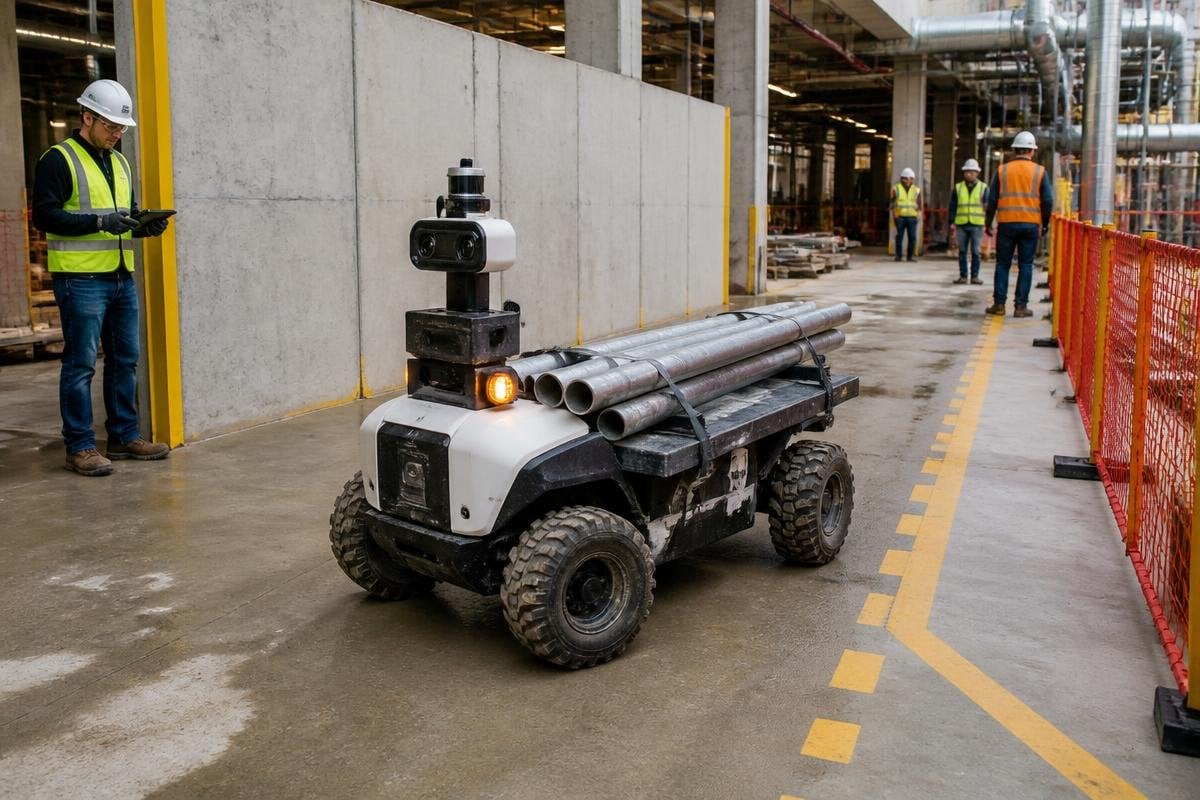
A machine that is safe beside a marked wall may be unsafe after a crew moves that wall. Construction sites change often, so safe robot work depends on fresh site checks, clear boundaries, and a way for people to stop the machine.
- Moveable hazards matter: barriers, tools, vehicles, and materials can change the robot’s route.
- Sensors need support: LiDAR and cameras work better when the site has clear signs and steady lighting.
- People need control: a visible emergency stop and a trained supervisor must be part of the plan.
Start with the task and the people nearby
Give the robot one defined job inside one defined area. Carrying materials along a marked route is easier to control than sending the same machine through a work zone shared by several trades.
The task also sets the safety plan. A mobile robot moving supplies needs a clear route and a safe stopping space. A robotic arm needs a fixed cell, guarding, and controls that stop motion when someone enters the area.
That boundary must match the real site, not an old drawing. If a forklift, crane, stack of timber, or temporary wall changes position, the crew needs a quick way to update the robot’s map or remove it from service.
Sensors are part of the plan, not the whole plan
LiDAR measures distance with laser scans. Cameras add visual detail. Bump sensors and emergency stops add another layer when software misses an object or a person moves into the route.
Each sensor has limits. Dust can affect cameras and laser sensors. Bright sunlight can change what a camera sees. Steel frames, glass, and uneven ground can also make detection harder.
The site plan should name these conditions and set a response for each one. The machine should slow or stop when its view is blocked.
It also needs a known stopping distance, because a machine that detects a person still needs space to halt. That distance should be checked after changes to speed, load, floor surface, or software.
Keep people in control of the work zone
Workers need to know where the robot can go, what it carries, and how to stop it. Signs alone are not enough when crews move between floors or enter an area through several access points.
A supervisor can check the route at the start of a shift, confirm that barriers are in place, and pause the robot when the site changes. The supervisor also needs a clear handoff process so one person knows who has control.
Construction companies should rehearse a stopped-robot response before live work begins. The plan should cover a blocked route, a lost sensor signal, a person inside the robot area, and a machine that stops with a load raised.
A site manager also needs dated examples of how robots stop and restart around crews. Construction robotics safety reporting can tie those actions to named machines and work sites before the next section looks at remote control.
Remote control helps, but it has limits
Teleoperation lets a person guide a robot when the machine reaches a task it cannot handle on its own. That can help with an unusual load or a route blocked by new site work.
The remote operator still needs a clear view of the robot and its surroundings. A video delay, lost connection, or camera blind spot can turn a small mistake into a collision. Remote control should pause the machine when the link fails, rather than leaving the last command active.
Autonomous work also needs a manual stop that people nearby can reach. A phone or control-room command may be useful, but it should not replace a local emergency stop for a machine working beside a crew.
Check the site before the first shift
Use this checklist before the robot starts work:
- Define the route: mark entry points, exit points, loading areas, and spaces where people may cross.
- Name the hazards: record moving vehicles, lifting work, open edges, loose materials, dust, and poor lighting.
- Check the stop: test the local emergency stop and confirm what motion stops when it is pressed.
- Set the response: write down who pauses the robot when the route changes or a sensor gives an error.
- Review the load: confirm the robot can carry the material without blocking its sensors or raising the load into a person’s path.
- Record each change: update the route after barriers, floors, equipment, or access points move.
Construction robots can work safely near crews when the machine has a narrow task, a controlled route, and a human response plan. I’d keep autonomous operation out of changing shared areas until the site team can show that the robot stops, stays stopped, and can be removed safely when conditions change.